

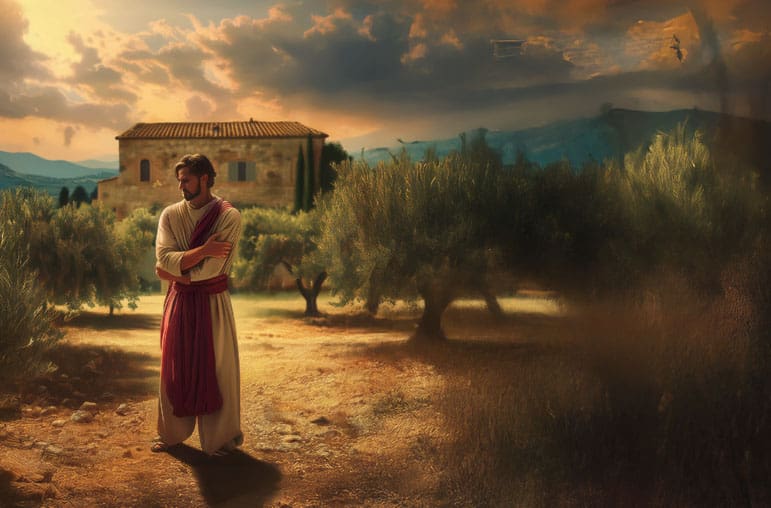
In the Gospel of Mark we meet a man whose life had been defined by loss. The passage says that he had a withered hand, but it does not tell us how long he had lived that way. It may have been years. It may have been most of his life. All we know is that by the time his story intersects with Jesus, the condition had already shaped his reality. His perceived end…became the beginning.
A withered hand in that culture meant far more than a physical limitation. It meant weakness, inability, and likely poverty. It could mean exclusion from normal work and participation in daily life. In many ways, this man lived on the margins—weak, withered, and perhaps of little use.
In other words, he was a social outcast, someone whose condition left him with very little hope.
Yet the most striking part of the story is not just his condition—it is where the story takes place. He was in a religious environment, surrounded by people who claimed to be devoted to God. But the religious leaders present that day were not interested in the man’s well-being. Instead, they were watching Jesus carefully, hoping to catch Him breaking their interpretation of the law.
They expected Jesus might heal the man, but their concern was not compassion; it was accusation. They were waiting for an opportunity to bring charges against Him.
The man with the withered hand was simply a case study to them.
This moment reveals an uncomfortable truth: religion can sometimes become more concerned with rules than with people. The religious leaders saw a law to protect. Jesus saw a man who needed restoration. That’s one of the major differences between being religious about God and being in a relationship with God.
The End…or Beginning?
This story echoes another moment in the Gospels—the woman with the issue of blood in the Gospel of Luke 8:43–48. Like the man with the withered hand, she had suffered for a long time and had run out of options. Situations like these represent what many people experience today: the place where strength is gone, resources are exhausted, and hope feels distant.
The withered hand symbolized more than a physical disability. It represented something weak, lifeless, and inoperable—something that seemed beyond repair.
Too many people know what that feels like. Are there times you can relate?
There are seasons when nothing seems to work. Dreams dry up. Efforts fail. Doors close. Situations that once had life seem withered and dead. Eventually, a person reaches the end of their own ability, the end of their resources, the end of their knowledge, and the end of their strength.
Those are difficult moments, but they can also be the moments where God begins to work in extraordinary ways.
At the end of our ability, God’s ability begins.
The turning point in the story happens when Jesus speaks directly to the man. Instead of offering sympathy or simply announcing a miracle, Jesus gives him a command: “Stretch out your hand.”
On the surface, that instruction seems almost unreasonable. If the man could have stretched out his hand on his own, he likely would have done so long before that day. His condition prevented him from doing exactly what Jesus was asking him to do; yet Jesus gave him an instruction that seemed impossible.
Why would He do that?
If you look through similar situations in scripture, you’ll see that the Lord often gives instructions that require faith.
A simple definition of faith is believing the Word of God is true, even when there is no physical evidence yet, and then acting in line with that Word.
When God speaks, He invites a response. I think we would all agree that the Word of God is powerful, but did you know that the power that’s in the Word is released when someone acts on it?

There are many examples of this in scripture; however, one instance is when Jesus invites Peter to come out onto the water with a simple Word of Invitation: “Come.” That one Word contained enough power to defy the natural law of physics to walk on top of the water. Why didn’t all the men in the boat get pulled out of the boat and onto the water? Because God’s invitations do not happen automatically. We must mix the Word we hear with faith (Hebrews 4:2) and respond to that Word with a corresponding action. Peter was the only one who responded to Jesus’ invitation. Therefore, he was the only one who experienced the power that the Word contained.
The man with the withered hand finds himself in a very similar situation.
That moment required him to decide how he would respond.
Would he remain frozen by the limitations of his condition? Would he allow his years of disability to define what he believed could happen? Or would he mix the Word that he had just heard with faith and respond to Jesus’ invitation?
Needless to say, he made the right choice. He stretched out his hand, and the miracle-working power of God was initiated when he responded in faith.
The text shows us something powerful: our limitations do not determine whether God’s Word comes to pass—our response does. The man acted on Jesus’ instruction despite the contradictory evidence of his condition. His hand had always been withered. His circumstances said nothing would change.
But he responded to the Word anyway.
And when he acted, God’s supernatural ability met him at the end of his own.
This is a principle that appears again and again throughout Scripture. James 2:14–17 reminds us that faith without works is dead. Faith is not simply agreeing with an idea; it is responding to God’s Word with a corresponding action that aligns with that Word. Likewise, Ephesians 2:8 teaches that faith accesses what grace has already provided.
The man with the withered hand did exactly that. He mixed faith with the Word he received.
The lesson is both simple and profound: acting on the Word of God releases the power in that Word to bring it to pass.
For many believers, the struggle is not whether God has promises for them. The struggle is deciding how to respond when life contradicts those promises. Hardships often tempt us to withdraw, complain, grow offended, or give up entirely.
But another response is possible.
Instead of reacting with frustration or defeat, a believer can seek a Word from God for their situation. They can meditate on that Word until it becomes real in their heart, and they can see it on the canvas of their imagination. They can begin declaring it, thanking God for it, and praising Him for the promise even before circumstances change.
That kind of approach will birth a faith response that aligns with His Word.
Sometimes all that is needed is exactly what the man in Mark’s Gospel received: a Word from God. Once he had that Word, the path forward became clear— “I must act on it, by faith.”
Even if the action seems impossible.
Even if the evidence says nothing will change.
Even if the condition has “always been that way.”
Because one truth stands at the center of this story: Just because something has always been that way does not mean it has to stay that way – not when God has already given us a promise that tells us we have victory in that area.
God still speaks into impossible situations. His promises give hope to people standing at the end of their own strength. And when those promises are met with faith-filled action, something powerful happens – God’s Word is manifested in the flesh.
The man walked into that gathering with a withered hand and very little hope.
But he walked out restored.
What looked like the end of his ability turned out to be the beginning of God’s intervention. And that is often how God works.

When human strength runs out…
When solutions disappear…
When hope feels thin…
You could be just one act of obedience to God’s Word away from your miracle.
Isn’t that what we celebrate every year during the Easter Season? It looked like the end. He was crucified and buried. All hope seemed to be lost, until His Word came to pass. The stone was rolled away. The tomb was empty. What looked like the end was actually just the beginning.
Feature Images: Man holding arm GENAI Text to Image; Scripture quotations marked KJV are taken from the KING JAMES VERSION of the Bible.